Our Three Step Process
January 5, 2026
The AI Revolution: How Artificial Intelligence is Redefining Enterprise Efficiency in 2026
Our Three Step Process
January 5, 2026
The AI Revolution: How Artificial Intelligence is Redefining Enterprise Efficiency in 2026
Artificial Intelligence is no longer just a buzzword—it's a fundamental shift in how we work and live. Explore the core pillars of AI, from Machine Learning to Generative models, and learn how to harness this 'intelligence era' to scale your business and outpace the competition
The conversation around Artificial Intelligence has moved from speculative sci-fi to a core boardroom imperative. In 2026, AI is no longer a distant future; it is the driving force behind unprecedented leaps in enterprise efficiency, innovation, and competitive advantage. Organizations that once viewed AI as an optional luxury now recognize it as a fundamental necessity for survival and growth.
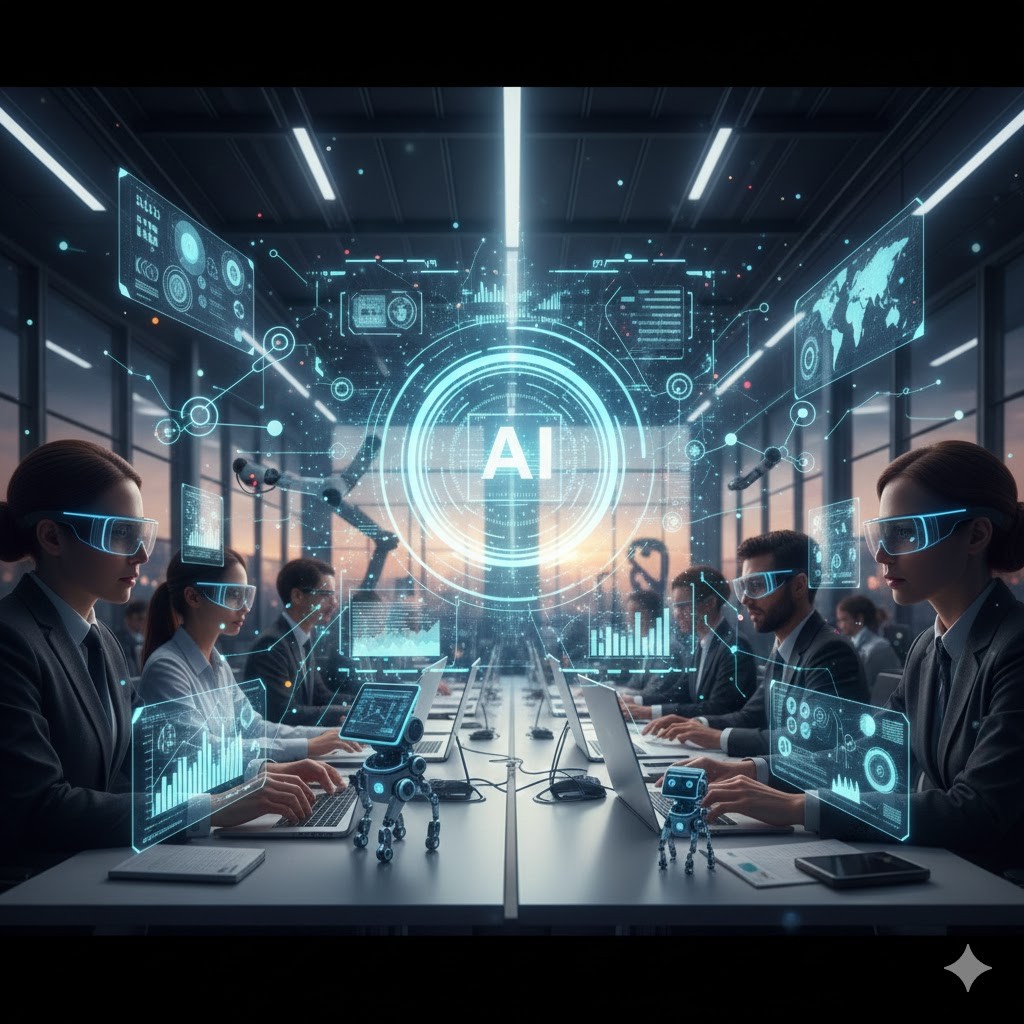
This blog post will delve into how AI is systematically reshaping every facet of the modern enterprise, from optimizing complex operations and automating mundane tasks to delivering personalized customer experiences and unlocking strategic insights that were once unimaginable. It's time to understand not just what AI is, but what it does for your bottom line. Here is an image of a futuristic office environment where humans are collaborating with AI-powered interfaces. A diverse group of professionals are interacting with holographic data visualizations and intelligent robots performing tasks in the background. The scene should convey efficiency and innovation.
Key Pillars of AI Transforming Enterprise Efficiency
In this blog post, we’ll explore the top AI technologies and provide guidance on how they are redefining enterprise efficiency.
1. Machine Learning (ML): The Engine of Prediction and Personalization
Overview: ML algorithms enable systems to learn from data, identify patterns, and make decisions with minimal human intervention. This is the foundational layer for most AI applications.
Key Applications:
Predictive Analytics: Forecasting sales, identifying maintenance needs for machinery, predicting customer churn.
Personalization: Tailoring recommendations for e-commerce, customizing user experiences on websites.
Fraud Detection: Identifying unusual transaction patterns in real-time.
Benefits: Reduces guesswork, optimizes resource allocation, enhances customer satisfaction through tailored experiences, and proactively mitigates risks.
2. Natural Language Processing (NLP): Communicating with Machines
Overview: NLP allows computers to understand, interpret, and generate human language. It's critical for interacting with vast amounts of text data and enabling conversational AI.
Key Applications:
Chatbots & Virtual Assistants: Automating customer support, answering FAQs, guiding users.
Sentiment Analysis: Understanding customer feedback from reviews, social media, and surveys.
Automated Content Generation: Drafting reports, summarizing documents, creating marketing copy.
Benefits: Improves customer service, streamlines internal communications, extracts valuable insights from unstructured data, and accelerates content creation.
3. Computer Vision: Giving Machines "Eyes"
Overview: Computer Vision enables computers to "see" and interpret visual information from images and videos, performing tasks like object detection, facial recognition, and scene understanding.
Key Applications:
Quality Control: Detecting defects on assembly lines, inspecting products for compliance.
Security & Surveillance: Monitoring premises, identifying anomalies, improving access control.
Retail Analytics: Analyzing store traffic, shelf optimization, understanding customer behavior.
Benefits: Automates visual inspection, enhances security, provides granular operational insights, and improves safety in industrial settings.
4. Generative AI: Creating the Future
Overview: Generative AI, spearheaded by large language models (LLMs) and diffusion models, can create entirely new content—text, images, code, video—based on learned patterns.
Key Applications:
Rapid Prototyping: Generating design concepts, architectural layouts, or marketing visuals.
Code Generation: Assisting developers by writing code snippets, debugging, and translating languages.
Personalized Marketing Content: Creating unique ad copy, email campaigns, or blog posts at scale.
Benefits: Dramatically accelerates ideation, content creation, and software development, fostering innovation and reducing time-to-market for new products and services.
Conclusion: Embracing the Intelligent Enterprise
The AI revolution is not a distant future; it's a present reality that is actively redefining what enterprise efficiency means. From intelligent automation to strategic decision-making, AI is empowering businesses to operate smarter, faster, and with unparalleled insight.
Ignoring this transformation is no longer an option. By strategically adopting and integrating these core AI pillars, businesses can unlock new levels of productivity, foster innovation, and secure their position at the forefront of the intelligent enterprise era.
The conversation around Artificial Intelligence has moved from speculative sci-fi to a core boardroom imperative. In 2026, AI is no longer a distant future; it is the driving force behind unprecedented leaps in enterprise efficiency, innovation, and competitive advantage. Organizations that once viewed AI as an optional luxury now recognize it as a fundamental necessity for survival and growth.
This blog post will delve into how AI is systematically reshaping every facet of the modern enterprise, from optimizing complex operations and automating mundane tasks to delivering personalized customer experiences and unlocking strategic insights that were once unimaginable. It's time to understand not just what AI is, but what it does for your bottom line. Here is an image of a futuristic office environment where humans are collaborating with AI-powered interfaces. A diverse group of professionals are interacting with holographic data visualizations and intelligent robots performing tasks in the background. The scene should convey efficiency and innovation.
Key Pillars of AI Transforming Enterprise Efficiency
In this blog post, we’ll explore the top AI technologies and provide guidance on how they are redefining enterprise efficiency.
1. Machine Learning (ML): The Engine of Prediction and Personalization
Overview: ML algorithms enable systems to learn from data, identify patterns, and make decisions with minimal human intervention. This is the foundational layer for most AI applications.
Key Applications:
Predictive Analytics: Forecasting sales, identifying maintenance needs for machinery, predicting customer churn.
Personalization: Tailoring recommendations for e-commerce, customizing user experiences on websites.
Fraud Detection: Identifying unusual transaction patterns in real-time.
Benefits: Reduces guesswork, optimizes resource allocation, enhances customer satisfaction through tailored experiences, and proactively mitigates risks.
2. Natural Language Processing (NLP): Communicating with Machines
Overview: NLP allows computers to understand, interpret, and generate human language. It's critical for interacting with vast amounts of text data and enabling conversational AI.
Key Applications:
Chatbots & Virtual Assistants: Automating customer support, answering FAQs, guiding users.
Sentiment Analysis: Understanding customer feedback from reviews, social media, and surveys.
Automated Content Generation: Drafting reports, summarizing documents, creating marketing copy.
Benefits: Improves customer service, streamlines internal communications, extracts valuable insights from unstructured data, and accelerates content creation.
3. Computer Vision: Giving Machines "Eyes"
Overview: Computer Vision enables computers to "see" and interpret visual information from images and videos, performing tasks like object detection, facial recognition, and scene understanding.
Key Applications:
Quality Control: Detecting defects on assembly lines, inspecting products for compliance.
Security & Surveillance: Monitoring premises, identifying anomalies, improving access control.
Retail Analytics: Analyzing store traffic, shelf optimization, understanding customer behavior.
Benefits: Automates visual inspection, enhances security, provides granular operational insights, and improves safety in industrial settings.
4. Generative AI: Creating the Future
Overview: Generative AI, spearheaded by large language models (LLMs) and diffusion models, can create entirely new content—text, images, code, video—based on learned patterns.
Key Applications:
Rapid Prototyping: Generating design concepts, architectural layouts, or marketing visuals.
Code Generation: Assisting developers by writing code snippets, debugging, and translating languages.
Personalized Marketing Content: Creating unique ad copy, email campaigns, or blog posts at scale.
Benefits: Dramatically accelerates ideation, content creation, and software development, fostering innovation and reducing time-to-market for new products and services.
Conclusion: Embracing the Intelligent Enterprise
The AI revolution is not a distant future; it's a present reality that is actively redefining what enterprise efficiency means. From intelligent automation to strategic decision-making, AI is empowering businesses to operate smarter, faster, and with unparalleled insight.
Ignoring this transformation is no longer an option. By strategically adopting and integrating these core AI pillars, businesses can unlock new levels of productivity, foster innovation, and secure their position at the forefront of the intelligent enterprise era.
Artificial Intelligence is no longer just a buzzword—it's a fundamental shift in how we work and live. Explore the core pillars of AI, from Machine Learning to Generative models, and learn how to harness this 'intelligence era' to scale your business and outpace the competition
The conversation around Artificial Intelligence has moved from speculative sci-fi to a core boardroom imperative. In 2026, AI is no longer a distant future; it is the driving force behind unprecedented leaps in enterprise efficiency, innovation, and competitive advantage. Organizations that once viewed AI as an optional luxury now recognize it as a fundamental necessity for survival and growth.
This blog post will delve into how AI is systematically reshaping every facet of the modern enterprise, from optimizing complex operations and automating mundane tasks to delivering personalized customer experiences and unlocking strategic insights that were once unimaginable. It's time to understand not just what AI is, but what it does for your bottom line. Here is an image of a futuristic office environment where humans are collaborating with AI-powered interfaces. A diverse group of professionals are interacting with holographic data visualizations and intelligent robots performing tasks in the background. The scene should convey efficiency and innovation.
Key Pillars of AI Transforming Enterprise Efficiency
In this blog post, we’ll explore the top AI technologies and provide guidance on how they are redefining enterprise efficiency.
1. Machine Learning (ML): The Engine of Prediction and Personalization
Overview: ML algorithms enable systems to learn from data, identify patterns, and make decisions with minimal human intervention. This is the foundational layer for most AI applications.
Key Applications:
Predictive Analytics: Forecasting sales, identifying maintenance needs for machinery, predicting customer churn.
Personalization: Tailoring recommendations for e-commerce, customizing user experiences on websites.
Fraud Detection: Identifying unusual transaction patterns in real-time.
Benefits: Reduces guesswork, optimizes resource allocation, enhances customer satisfaction through tailored experiences, and proactively mitigates risks.
2. Natural Language Processing (NLP): Communicating with Machines
Overview: NLP allows computers to understand, interpret, and generate human language. It's critical for interacting with vast amounts of text data and enabling conversational AI.
Key Applications:
Chatbots & Virtual Assistants: Automating customer support, answering FAQs, guiding users.
Sentiment Analysis: Understanding customer feedback from reviews, social media, and surveys.
Automated Content Generation: Drafting reports, summarizing documents, creating marketing copy.
Benefits: Improves customer service, streamlines internal communications, extracts valuable insights from unstructured data, and accelerates content creation.
3. Computer Vision: Giving Machines "Eyes"
Overview: Computer Vision enables computers to "see" and interpret visual information from images and videos, performing tasks like object detection, facial recognition, and scene understanding.
Key Applications:
Quality Control: Detecting defects on assembly lines, inspecting products for compliance.
Security & Surveillance: Monitoring premises, identifying anomalies, improving access control.
Retail Analytics: Analyzing store traffic, shelf optimization, understanding customer behavior.
Benefits: Automates visual inspection, enhances security, provides granular operational insights, and improves safety in industrial settings.
4. Generative AI: Creating the Future
Overview: Generative AI, spearheaded by large language models (LLMs) and diffusion models, can create entirely new content—text, images, code, video—based on learned patterns.
Key Applications:
Rapid Prototyping: Generating design concepts, architectural layouts, or marketing visuals.
Code Generation: Assisting developers by writing code snippets, debugging, and translating languages.
Personalized Marketing Content: Creating unique ad copy, email campaigns, or blog posts at scale.
Benefits: Dramatically accelerates ideation, content creation, and software development, fostering innovation and reducing time-to-market for new products and services.
Conclusion: Embracing the Intelligent Enterprise
The AI revolution is not a distant future; it's a present reality that is actively redefining what enterprise efficiency means. From intelligent automation to strategic decision-making, AI is empowering businesses to operate smarter, faster, and with unparalleled insight.
Ignoring this transformation is no longer an option. By strategically adopting and integrating these core AI pillars, businesses can unlock new levels of productivity, foster innovation, and secure their position at the forefront of the intelligent enterprise era.
Other Blogs
Other Blogs
Check our other project Blogs with useful insight and information for your businesses
Featured
Jan 28, 2026
News
Cloud Development for Business: Your Guide to 2026's Essential Digital Foundation

Featured
Jan 28, 2026
News
Cloud Development for Business: Your Guide to 2026's Essential Digital Foundation
Featured
Dec 30, 2025
News
The Future of Efficiency: A Deep Dive into RPA for Websites
Featured
Dec 30, 2025
News
The Future of Efficiency: A Deep Dive into RPA for Websites
Featured
Jan 2, 2026
Article
The Immersive Revolution: How AR & VR are Transforming the Modern Enterprise

Featured
Jan 2, 2026
Article
The Immersive Revolution: How AR & VR are Transforming the Modern Enterprise
Other Blogs
Other Blogs
Check our other project Blogs with useful insight and information for your businesses
Featured
Jan 28, 2026
News
Cloud Development for Business: Your Guide to 2026's Essential Digital Foundation
Featured
Dec 30, 2025
News
The Future of Efficiency: A Deep Dive into RPA for Websites
Featured
Jan 2, 2026
Article
The Immersive Revolution: How AR & VR are Transforming the Modern Enterprise