Our Three Step Process
January 2, 2026
The Immersive Revolution: How AR & VR are Transforming the Modern Enterprise
Our Three Step Process
January 2, 2026
The Immersive Revolution: How AR & VR are Transforming the Modern Enterprise
Step into the future with Augmented Reality (AR) and Virtual Reality (VR). This blog explores how AR/VR is transforming industries from healthcare to retail, offering immersive experiences and new possibilities for business and innovation."
In this blog post, we'll explore the e’ll explore the world of immersive technology and provide guidance on selecting the right solution for your business's needs.
The line between the digital and physical worlds is blurring, and at the forefront of this convergence are Augmented Reality (AR) and Virtual Reality (VR). More than just gaming technologies, AR and VR are powerful tools that are fundamentally changing how we interact with information, collaborate, train, and experience our surroundings.
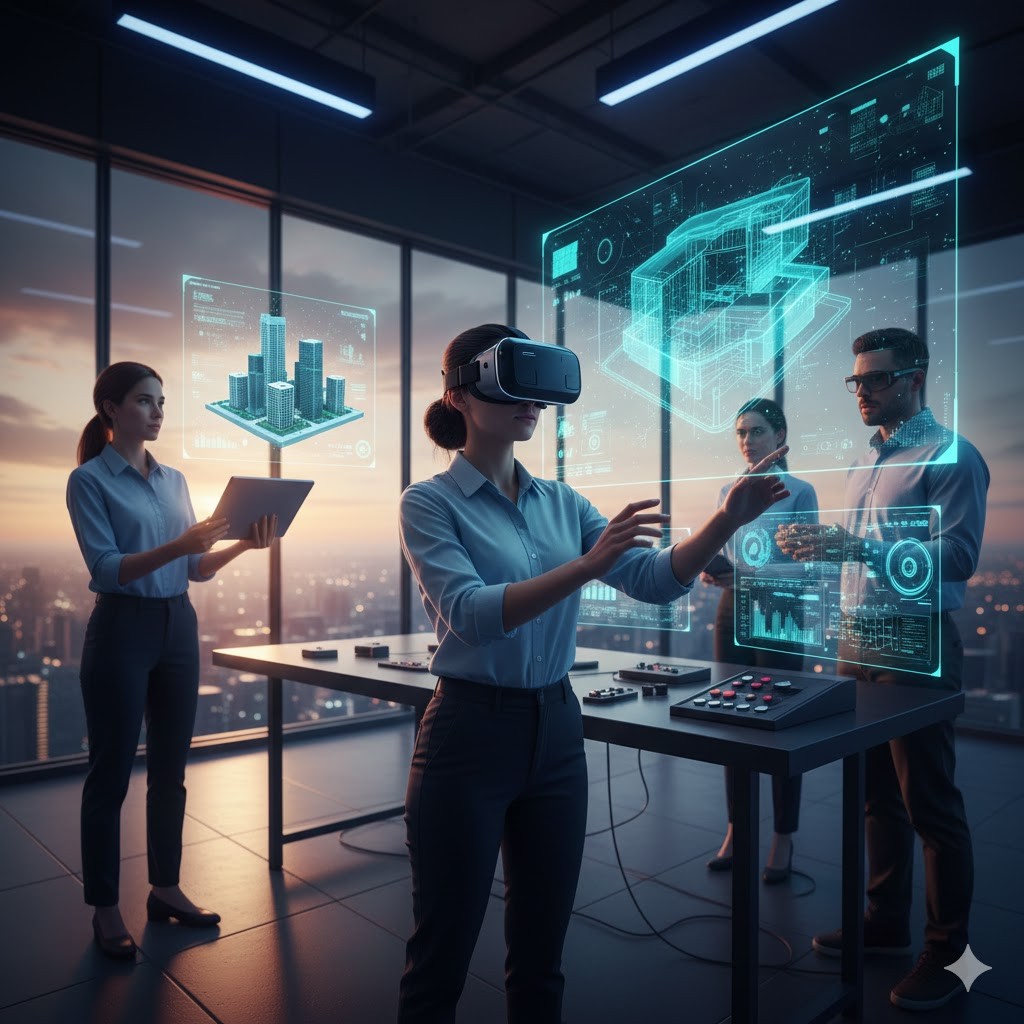
From enhancing real-world environments with digital overlays to transporting users to entirely new virtual spaces, these technologies are unlocking unprecedented levels of engagement and efficiency across every sector. Here is an image of a person wearing an AR/VR headset, interacting with floating holographic elements in a modern, dynamic environment.
Understanding AR and VR: A Quick Dive
While often grouped together, AR and VR offer distinct yet complementary experiences:
Augmented Reality (AR):
Overview: AR overlays digital information onto the real world through devices like smartphones, tablets, or smart glasses. It enhances existing reality without fully immersing the user in a virtual environment.
Key Features: Real-time object recognition, digital content overlay, interactive 3D models within a physical space.
Examples: Pokémon GO, IKEA Place app (visualizing furniture in your home), surgical overlays for doctors.
Virtual Reality (VR):
Overview: VR creates an entirely simulated environment that can be similar to or completely different from the real world. Users are fully immersed, typically through a headset, blocking out physical surroundings.
Key Features: 360-degree immersive environments, motion tracking for realistic interaction, haptic feedback integration.
Examples: Gaming (e.g., Beat Saber), flight simulators, virtual tourism, remote surgery training.
Transforming Industries: Beyond Entertainment
The impact of AR and VR extends far beyond gaming and entertainment:
Healthcare:
Overview: AR and VR are revolutionizing medical training, surgical planning, and patient care.
Applications: Surgeons use AR overlays for precise operations; VR provides immersive training for complex procedures; patients manage pain or anxiety through therapeutic VR experiences.
Benefits: Enhanced precision, accelerated learning, improved patient outcomes, and reduced risks in medical practice.
Retail & E-commerce:
Overview: AR is bridging the gap between online shopping and real-world visualization, while VR offers immersive virtual storefronts.
Applications: Customers use AR apps to virtually try on clothes or place furniture in their homes; VR showrooms allow for immersive product exploration.
Benefits: Increased customer confidence, reduced return rates, personalized shopping experiences, and expanded reach for brands.
Manufacturing & Engineering:
Overview: AR and VR are enhancing design, assembly, maintenance, and quality control processes.
Applications: Engineers use AR to overlay digital schematics onto physical machinery for assembly or repair; VR simulations test product designs in virtual environments.
Benefits: Faster prototyping, fewer errors, improved safety during maintenance, and efficient workforce training.
Education & Training:
Overview: AR and VR are creating engaging, interactive learning experiences that go beyond traditional textbooks and lectures.
Applications: Students explore historical sites in VR; AR apps bring textbook diagrams to life; employees receive hands-on training for dangerous tasks in a safe, virtual environment.
Benefits: Higher engagement, better retention of information, practical skill development, and accessible learning for diverse learners.
Conclusion: Stepping into the Future
Augmented Reality and Virtual Reality are no longer futuristic concepts; they are here, and they are rapidly reshaping how businesses operate, how professionals train, and how consumers interact with the world around them. The immersive revolution promises not just new tools, but entirely new paradigms for problem-solving and innovation.
In this blog post, we'll explore the e’ll explore the world of immersive technology and provide guidance on selecting the right solution for your business's needs.
The line between the digital and physical worlds is blurring, and at the forefront of this convergence are Augmented Reality (AR) and Virtual Reality (VR). More than just gaming technologies, AR and VR are powerful tools that are fundamentally changing how we interact with information, collaborate, train, and experience our surroundings.
From enhancing real-world environments with digital overlays to transporting users to entirely new virtual spaces, these technologies are unlocking unprecedented levels of engagement and efficiency across every sector. Here is an image of a person wearing an AR/VR headset, interacting with floating holographic elements in a modern, dynamic environment.
Understanding AR and VR: A Quick Dive
While often grouped together, AR and VR offer distinct yet complementary experiences:
Augmented Reality (AR):
Overview: AR overlays digital information onto the real world through devices like smartphones, tablets, or smart glasses. It enhances existing reality without fully immersing the user in a virtual environment.
Key Features: Real-time object recognition, digital content overlay, interactive 3D models within a physical space.
Examples: Pokémon GO, IKEA Place app (visualizing furniture in your home), surgical overlays for doctors.
Virtual Reality (VR):
Overview: VR creates an entirely simulated environment that can be similar to or completely different from the real world. Users are fully immersed, typically through a headset, blocking out physical surroundings.
Key Features: 360-degree immersive environments, motion tracking for realistic interaction, haptic feedback integration.
Examples: Gaming (e.g., Beat Saber), flight simulators, virtual tourism, remote surgery training.
Transforming Industries: Beyond Entertainment
The impact of AR and VR extends far beyond gaming and entertainment:
Healthcare:
Overview: AR and VR are revolutionizing medical training, surgical planning, and patient care.
Applications: Surgeons use AR overlays for precise operations; VR provides immersive training for complex procedures; patients manage pain or anxiety through therapeutic VR experiences.
Benefits: Enhanced precision, accelerated learning, improved patient outcomes, and reduced risks in medical practice.
Retail & E-commerce:
Overview: AR is bridging the gap between online shopping and real-world visualization, while VR offers immersive virtual storefronts.
Applications: Customers use AR apps to virtually try on clothes or place furniture in their homes; VR showrooms allow for immersive product exploration.
Benefits: Increased customer confidence, reduced return rates, personalized shopping experiences, and expanded reach for brands.
Manufacturing & Engineering:
Overview: AR and VR are enhancing design, assembly, maintenance, and quality control processes.
Applications: Engineers use AR to overlay digital schematics onto physical machinery for assembly or repair; VR simulations test product designs in virtual environments.
Benefits: Faster prototyping, fewer errors, improved safety during maintenance, and efficient workforce training.
Education & Training:
Overview: AR and VR are creating engaging, interactive learning experiences that go beyond traditional textbooks and lectures.
Applications: Students explore historical sites in VR; AR apps bring textbook diagrams to life; employees receive hands-on training for dangerous tasks in a safe, virtual environment.
Benefits: Higher engagement, better retention of information, practical skill development, and accessible learning for diverse learners.
Conclusion: Stepping into the Future
Augmented Reality and Virtual Reality are no longer futuristic concepts; they are here, and they are rapidly reshaping how businesses operate, how professionals train, and how consumers interact with the world around them. The immersive revolution promises not just new tools, but entirely new paradigms for problem-solving and innovation.
Step into the future with Augmented Reality (AR) and Virtual Reality (VR). This blog explores how AR/VR is transforming industries from healthcare to retail, offering immersive experiences and new possibilities for business and innovation."
In this blog post, we'll explore the e’ll explore the world of immersive technology and provide guidance on selecting the right solution for your business's needs.
The line between the digital and physical worlds is blurring, and at the forefront of this convergence are Augmented Reality (AR) and Virtual Reality (VR). More than just gaming technologies, AR and VR are powerful tools that are fundamentally changing how we interact with information, collaborate, train, and experience our surroundings.
From enhancing real-world environments with digital overlays to transporting users to entirely new virtual spaces, these technologies are unlocking unprecedented levels of engagement and efficiency across every sector. Here is an image of a person wearing an AR/VR headset, interacting with floating holographic elements in a modern, dynamic environment.
Understanding AR and VR: A Quick Dive
While often grouped together, AR and VR offer distinct yet complementary experiences:
Augmented Reality (AR):
Overview: AR overlays digital information onto the real world through devices like smartphones, tablets, or smart glasses. It enhances existing reality without fully immersing the user in a virtual environment.
Key Features: Real-time object recognition, digital content overlay, interactive 3D models within a physical space.
Examples: Pokémon GO, IKEA Place app (visualizing furniture in your home), surgical overlays for doctors.
Virtual Reality (VR):
Overview: VR creates an entirely simulated environment that can be similar to or completely different from the real world. Users are fully immersed, typically through a headset, blocking out physical surroundings.
Key Features: 360-degree immersive environments, motion tracking for realistic interaction, haptic feedback integration.
Examples: Gaming (e.g., Beat Saber), flight simulators, virtual tourism, remote surgery training.
Transforming Industries: Beyond Entertainment
The impact of AR and VR extends far beyond gaming and entertainment:
Healthcare:
Overview: AR and VR are revolutionizing medical training, surgical planning, and patient care.
Applications: Surgeons use AR overlays for precise operations; VR provides immersive training for complex procedures; patients manage pain or anxiety through therapeutic VR experiences.
Benefits: Enhanced precision, accelerated learning, improved patient outcomes, and reduced risks in medical practice.
Retail & E-commerce:
Overview: AR is bridging the gap between online shopping and real-world visualization, while VR offers immersive virtual storefronts.
Applications: Customers use AR apps to virtually try on clothes or place furniture in their homes; VR showrooms allow for immersive product exploration.
Benefits: Increased customer confidence, reduced return rates, personalized shopping experiences, and expanded reach for brands.
Manufacturing & Engineering:
Overview: AR and VR are enhancing design, assembly, maintenance, and quality control processes.
Applications: Engineers use AR to overlay digital schematics onto physical machinery for assembly or repair; VR simulations test product designs in virtual environments.
Benefits: Faster prototyping, fewer errors, improved safety during maintenance, and efficient workforce training.
Education & Training:
Overview: AR and VR are creating engaging, interactive learning experiences that go beyond traditional textbooks and lectures.
Applications: Students explore historical sites in VR; AR apps bring textbook diagrams to life; employees receive hands-on training for dangerous tasks in a safe, virtual environment.
Benefits: Higher engagement, better retention of information, practical skill development, and accessible learning for diverse learners.
Conclusion: Stepping into the Future
Augmented Reality and Virtual Reality are no longer futuristic concepts; they are here, and they are rapidly reshaping how businesses operate, how professionals train, and how consumers interact with the world around them. The immersive revolution promises not just new tools, but entirely new paradigms for problem-solving and innovation.
Other Blogs
Other Blogs
Check our other project Blogs with useful insight and information for your businesses
Featured
Jan 28, 2026
News
Cloud Development for Business: Your Guide to 2026's Essential Digital Foundation

Featured
Jan 28, 2026
News
Cloud Development for Business: Your Guide to 2026's Essential Digital Foundation
Featured
Dec 30, 2025
News
The Future of Efficiency: A Deep Dive into RPA for Websites

Featured
Dec 30, 2025
News
The Future of Efficiency: A Deep Dive into RPA for Websites
Featured
Jan 4, 2026
News
The Battle of the Clouds: Choosing Between AWS, Microsoft Azure, and Google Cloud

Featured
Jan 4, 2026
News
The Battle of the Clouds: Choosing Between AWS, Microsoft Azure, and Google Cloud
Other Blogs
Other Blogs
Check our other project Blogs with useful insight and information for your businesses
Featured
Jan 28, 2026
News
Cloud Development for Business: Your Guide to 2026's Essential Digital Foundation
Featured
Dec 30, 2025
News
The Future of Efficiency: A Deep Dive into RPA for Websites
Featured
Jan 4, 2026
News
The Battle of the Clouds: Choosing Between AWS, Microsoft Azure, and Google Cloud